What we control, and what only testing can tell you.
A baby garment has to be safe before it has to be anything else. Some of that is process and we control it directly. Some of it is testing and certification, and that depends on the product, the market and the age group.
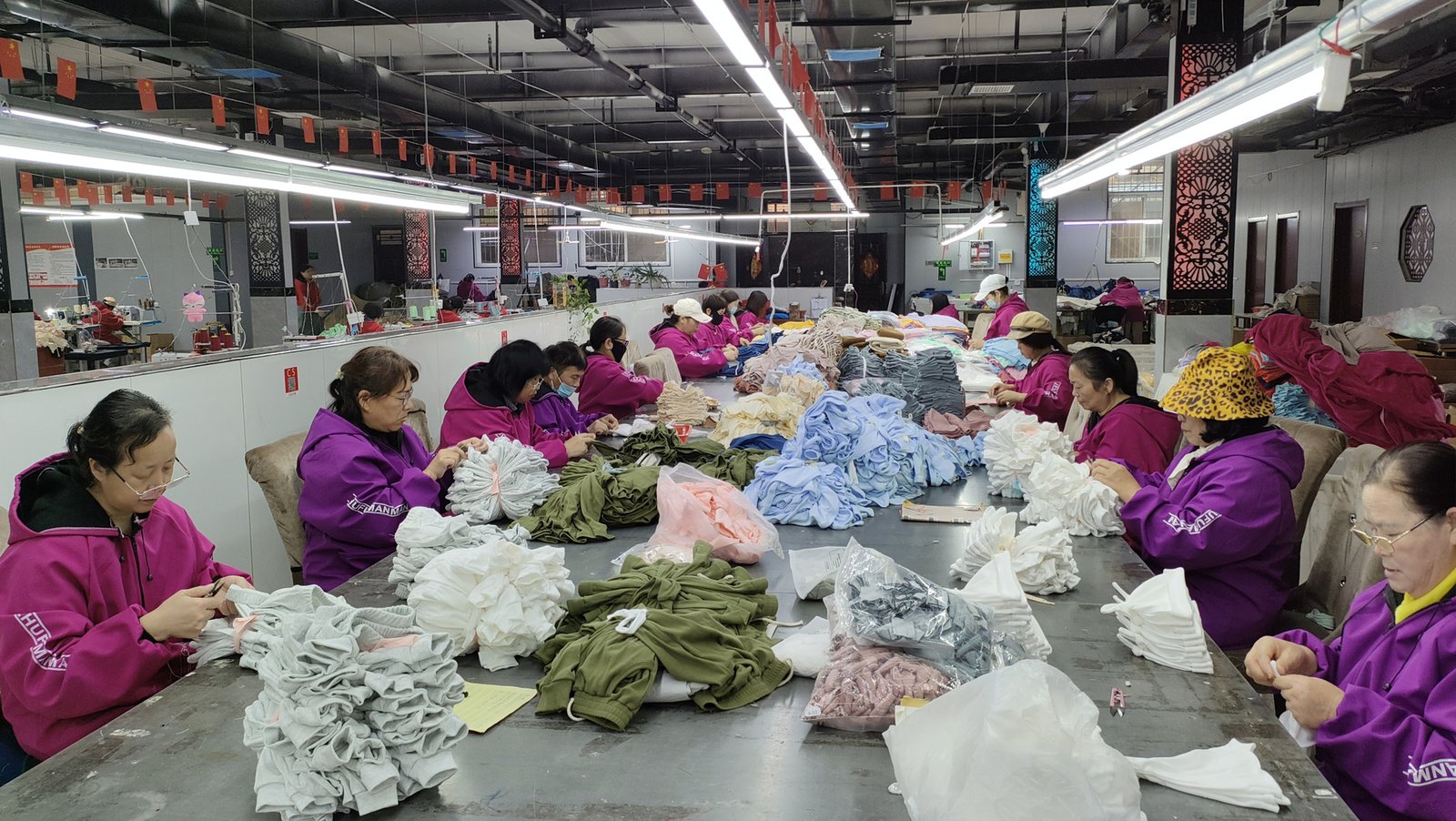
Six things we do on every order
01
Material first
A garment that irritates a baby's skin has failed regardless of how well it is sewn. We buy cotton and bamboo qualities on hand-feel and skin-contact behaviour, and we tell you when a cheaper quality would compromise that.
02
No metal in the garment
Every finished lot passes needle detection. Metal detection is the last control before packing and it is applied to every order, not to a sample.
03
Snaps and small parts are pulled, not assumed
Snap fasteners, buttons and applied trims are pull-tested. A fastener that releases under load is a choking hazard in the under-three age group, which is the age group most of this range is sold into.
04
Nothing sharp, nothing loose
Zip pulls, snap covers and trim edges are checked for sharp points and edges. Drawcords are avoided in the under-three range rather than shortened to a legal minimum.
05
The label is part of the product
Fibre content, care instructions, country of origin and any required tracking mark are applied at production. A garment that cannot be legally sold in its destination market is not a finished garment.
06
Documents are dated, and dated documents are disclosed
A certificate is only evidence while it is valid and while it covers the product in question. Our certifications page lists the holder, scope and printed expiry date of every document on file, including the ones that have expired.
Where the process stops and the laboratory starts
Some requirements cannot be verified by inspection. Flammability, migration of certain elements, phthalate content, lead in substrate — these are laboratory determinations against a specific standard, on a specific product, for a specific market.
What we can do is tell you exactly which documents we hold, what each one covers and what it does not, and arrange the testing your order needs. What we will not do is tell you a garment is compliant when the determination belongs to the importer of record.
- Documents published with holder, scope and printed expiry date
- Expired certificates marked as expired, not quietly removed
- Certificates naming a partner mill identified as such
- Testing arranged against the standard your market requires
The four fabrics, and why they were chosen
French Terry
Brushed-back French terry
French terry is a knitted loop fabric: smooth on the face, with the soft loops left on the back. It holds shape through washing, drapes without clinging and takes ribbing cleanly at cuffs and hems, which is why it carries almost every sweatshirt, hoodie, jogger and romper in this series.
- Weight220–320 gsm
- CompositionCotton, cotton/elastane, cotton/polyester
- Typical useSweatshirts, hoodies, joggers, bubble rompers, dungarees, shorts
Pointelle & Jacquard
Pointelle / jacquard knit
Pointelle is a fine-gauge knit with deliberate eyelet columns worked into the structure. The result is a fabric that breathes harder than plain jersey at the same weight, which is what makes it the default choice for newborn layering.
- Weight150–190 gsm
- CompositionOrganic cotton, cotton/elastane
- Typical useBodysuits, pants, knot hats, receiving blankets
Interlock
Interlock / brushed interlock
Interlock knits two smooth faces back to back, so the fabric has no wrong side, no curl at a raw edge and no tendency to twist after washing. It is the most forgiving knit to cut and sew, and the reason it carries the bulk of our bodysuit and sleeper production.
- Weight180–240 gsm
- Composition100% organic cotton, cotton/elastane
- Typical useBodysuits, sleepers, rompers, bibs, hats, pants
Bamboo Jersey
Bamboo viscose jersey
Bamboo viscose knits to a dense, fluid jersey with a soft sheen and a naturally cool hand. It drapes where cotton stands away from the body, which is why it suits dresses and warm-weather sets rather than structured sweats.
- Weight170–200 gsm
- CompositionBamboo viscose, bamboo/cotton, bamboo/elastane
- Typical useDresses, rompers, zip sleepsuits, two-piece sets
Answered precisely, including the awkward ones
Are your products tested for the US market?
A Children's Products Certificate (CPC) is on file for a French terry baby clothing set, style BS48F, issued 2024-09-12 by TÜV SÜD. It covers that product as listed on the certificate. It is not a blanket certification of the whole range, and a new CPC is issued against each shipment and each style. Ask us for the copy matching your order.
Are your products tested for the European and UK markets?
Two documents are on file covering a baby comforter blanket, model BSE36F: a CE Certificate of Conformity dated 2025-07-29 citing EN 71-1, EN 71-2 and EN 71-3, and a UKCA Certificate of Compliance dated 2024-11-04 citing the equivalent BS EN 71 parts. Both name the model and the manufacturer they cover. They do not certify the wider range.
What does the GOTS certificate cover?
A GOTS scope certificate is on file for Henan Aston Garment Co., Ltd., license GOTS-BVCN6580, issued 2025-04-03 and valid until 2026-04-02 — that date has now passed, so it should not be presented as a live credential. The process category listed on it is trading, and the product categories include babies' apparel. We will tell you the current position when you enquire.
Is the OEKO-TEX certificate yours?
No. The STANDARD 100 certificate on file, BEKO 055792, is held by Jiangsu Wulong Knitting Co., Ltd., the knitting mill that supplies the fabric, and it expired on 2026-03-15. It is a fabric-level certificate, not a garment certificate, and we show it as such.
Is the BSCI audit yours?
No. The amfori BSCI monitoring summary on file is for Hua Xian Zhongda Garment Knitting Co., Ltd., a partner sewing factory, monitored by TÜV Rheinland in November 2024. Its printed expiration date of 2025-11-29 has passed, its overall rating was C, and the working-hours section was rated D. We show it because it is the document on file, not because it is a strong credential.
Do you guarantee compliance with a specific regulation?
No, and no factory should. Compliance obligations attach to the product, the market, the age group and the importer of record. We will tell you exactly which document we hold, what it covers and what it does not, and we will arrange the testing your order needs. The legal determination is yours or your compliance adviser's.
Textile and children's-product requirements differ by country, by age group and by material, and they change. The descriptions on this page reflect the documents we hold as printed. Determining which rules apply to your product in your market is a job for you and your compliance adviser — and we will give you whatever documentation we have to help with it.
Need the documentation for your market?
Tell us the market and the age group and we will tell you which documents we hold, what they cover, and where the gaps are.